
> Intro
• Create
— Panoramas: Create —
How a panorama is made
A series of photographs are needed for a panorama. The camera stays at the same place and is rotated and/or tilted.
Generally, panoramas can be photographed with any camera, from the cheapest «Click-o-Matic» and smartphone to the Spheron SpheroCamHDR, depending on the budget. Cylindrical panoramas can be shot with the handheld camera, the result may be such that there is something left to be desired — but it is do-able. A digital camera is an advantage but not mandatory.

A cylindrical panorama made from six photographs glued together, the seventh photograph is a copy of the first one. Another example made from 11 photographs, the 12th again a copy of the first (both panoamas from the early seventies: Dartmoor, England and Font Romeau, Pyrenees, France).

There is a difficulty to correct photographic prints and the lower example shows what happens if the camera was not correctly aligned horizontally. To align the camera horizontal, a bubble level is almost mandatory. There are some very handy ones that can be put on the holder for the flashlight.
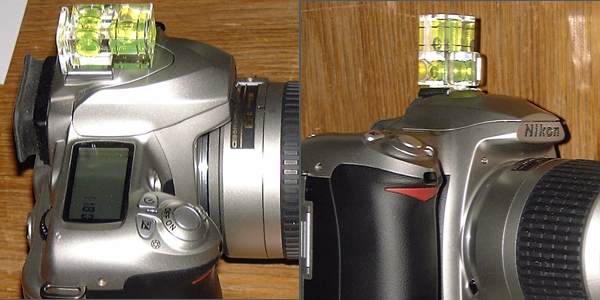
When purchasing a level, check that it can be fixed also turned by 90° to assure the levels also work if the camera is set for a portrait shot. Even though panoramas can be made with the handheld camera, the use of a stable tripot is highly recommended.
In order to get more height from the scenery , move the camera in portrait position. More pictures will be needed to get a full circle, of course.
When the camera is rotated or tilted for the next exposure, keep in mind that at least 10% of the scenery from the previous picture is shown in the new one. If a wide angle lens is used, more overlap is necessary because such a lens distorts considerably towards the edges. These distortions must be calculated and compensated for by the «Stitcher» in order to assemble the pictures seamless to a panorama. For a cylindrical 360° panorama, you soon end up with a dozen or more photographs.
Parallax-Errors
Horizontal and vertical cylindrical panoramas can be made with the handheld camera,
better use a tripod, though. What has been just said applies for wide landscapes. It
does not apply to panoramas made in a room or with objects close to the camera. A
perfect panorama in a room necessitates that the camera is rotated and tilted at the
exact focal point. This is not the case for a handheld camera — not even if one
turns around on the own axes — and neither on the tripod. The solution is a
panorama-head on the tripod. Panorama-heads can be purchased for a relatively high
price, but can be home made with some mechanical aptitude. Several examples of
successful tinkering can be found on the Internet.
DSLR FX and DX Formats
The FX is the standard for the 35 mm format 24 mm x 36 mm. The focal length of all
interchangeable lenses refer to this format. The DX format is 16 mm x 24 mm, 2/3
if the FX format. A 200 mm tele-lens is a 200 mm tele-lens for an FX camera but a
300 mm lens for a DX camera. This is great; it is less great for panoramas because
a 18 mm wide-angle lens becomes a 27 mm lens and instead of covering 100° diagonal
only covers 76°.
Fisheye
There are circular and fullframe fisheye lenses. The circular lens
captures 180° and creates a circular image in a rectangle with a diameter of
the shorter side of the film or chip. If the camera is aimed to the zenith, the
full sky down to the horizon can be captured. If the camera is held horizontal,
three shots horizontally 120° apart suffice for a panorama.
The fullframe fisheye covers 180° on the diagonal of the frame. The usual aspect ratio of a 35 mm camera is 3:2 and the longer side covers 144° and the shorter 86°. If a panorama is photographed with the camera held in the portrait format, 6 shots at horizontal steps of 60° are necessary; and one zenith shot, better two 90° apart.
Spherical Panoramas
It is almost impossible to do spherical panoramas without a panorama-head and a tripod.
Generally, you go about it the same way as for a horizontal cylindrical panorama. After
each full turn, the camera is tilted upwards and another full circle is photographed, then
again tilted upwards and so on until there is only one single zenith photograph left. This
is repeated downwards. The last picture for the nadir is done with the camera handheld
after the tripod has been put out of the way. To get the nadir right in the final panorama,
a bit of cheating cannot be prevented. Depending on the lens used, quite a few photographs
are needed to get a complete panorama.
Of course, you could always use a mirrror ball, as shown under the HDRI topic. But the quality is very much lower. The maximal size will be the shorter side of the film or chip exactly as it is when using a circular fisheye.
© 2004 - 2018 by Horo Wernli.